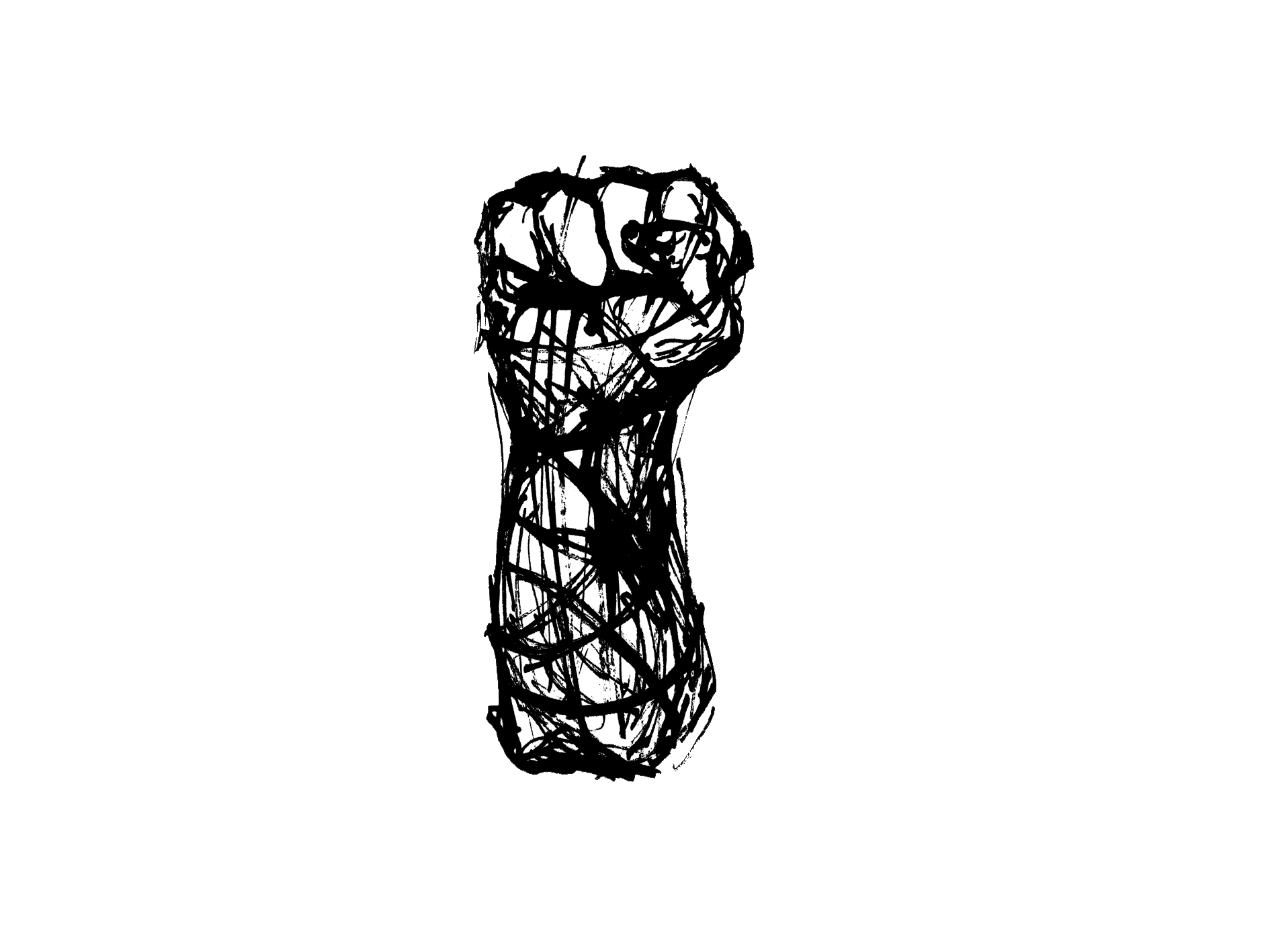

A Solo show
11 September - 31 October 2025
Project 88 Colaba, Mumbai, India
Installation with -11 screen printed posters on Lokta paper (Nepali handmade paper); an A6 format artist's book titled Weaving Labyrinth; eight collaboratively published zines; one booklet on the Anti-Deocha Pachami Coal Project; ten oil paintings on Masonite board, 4 × 4 in. each; six oil paintings on canvas, 8 × 5 ft each; two oil paintings on canvas, 6 × 4 ft each; two oil paintings on canvas, 1 × 2 ft each; two black pigment and distemper drawings on uncut acid-free paper (300 gsm), 5 × 33 ft each; one Chinese ink drawing on Lokta paper (Nepali handmade paper), 4 × 1.6 ft; a series of thirty-two black-and-white ink drawings on cotton cloth, 6 × 6 in. each; a sonic sculptural work with bamboo titled Less than 8 Hours, 6 in. × 50 ft; a collaborative video work titled 7 Broken Stories, duration 24 min 52 sec, presented on a 16-inch black-and-white television monitor; and an LED text panel featuring Moumita Alam's poem Where is My City?, 1 × 14 ft.
Exhibition text:
Land is not inert; it is a historically sedimented, sensorial and semiotic matrix where life, language, and affects are co-constituted. Its contours shape the movement of bodies, seeds, waters, and life-stories, while language shapes and is shaped by the textures of soil and life-forms, the rhythms of labour, and the cyphers of seasonality.
From everyday idioms to cosmologies of belonging, this immanent language structures how land is perceived, narrated, and valued and how cohabitation is imagined.
Sovereignty is a relational ontology grounded in custodianship, cosmological entanglement, and subsistence practices, emerging from an organic, non-extractive reciprocity with the land. Belonging here is enacted through long kinship with nonhuman entities.
The onset of colonial grammars or capitalist nomenclatures subsumed these situated semiotic ecologies, flattening them, producing epistemic dispossession and interrupting historic bonds of land, life, and expression. Caste society also inscribed anti-ecological partitioning of access, labour, and proximity to nature.
Their reflections appear in colonial cartographies and modernist abstractions, where imagining landscape becomes a key site of technologies of power, an incessant longing for terra incognita for mapping, aestheticizing and expansionism.
Violence of dispossession, enclosure, erosion, blockage and extraction lie veiled under regimes of visual representation :
Rendering land as the picturesque void, a surface emptied of its lived ecologies, levelling the language of everyday workmanship, and excising its rights-bearing histories.
Culturizing land; as heritage without politics; as sceneries without sovereignty; ensuing hegemonic anointing and sanctification of language.
Itemizing land as divisible asset, acquiescent to special economic regimes, and developmentalist logics, while post-truth rhetorics consume language and permeate everyday speech, they converge with the State and its private militias to bulldoze lifeworlds under the pretext of legality.
The “-ing” verbs signal continuous processes of appropriation and control over land and resources, emphasizing ongoingness of the relentless exertions of power.
At the peak of this necroecological hour, imagining a language rooted in the semiotic matrix of land, constituting and imagining a counter-hegemonic presence and praxis-sustaining polysemic infrastructure of sensing and relating, remains critically urgent. Drawing lineages to language that have carried the murmurs of resistance, whispering through fields and forests, encrypting refusal in idioms of soil and season, inscribing our insurgent memories across epochs of conquest. Our terrains still speak in multiplicities – upholding the polyphonic archives of lives lived, subverting the homogenizing grammars and syntactic regimes of accumulation.
By Pinak Banik
The working man asserts his existence, be it through bramble and bush, or the impermeable layers of hegemonic hierarchy. He does so casu- ally and with an attitude - cigarette in one hand and a coconut tree in the other. He is not to be underestimated- with a head on fire, he simmers in anger - waiting to boil over. His shirt drips with white, rendered in expensive paint ordinarily reserved for depictions of luxurious, ivory clothing. His sandals are not worn or broken. Everything about him rejects victimhood- the superficial clas- sist narratives of poverty. He tramples a roti- a crescent moon - in complete refusal of his objec- tive circumstances. After all, he is the sovereign custodian of his land. He is also presented as a vagabond- a man eith no fixed income or home- that is free from the constraints of capitalist sys- tems by existing on its fringes, challenging the notion that control is power.
A memory of a shamiana that would host tradition- al ‘nataks’ stands among a variety of native blooms that were once wild, but are now only found in manicured gardens. Within this foliage, also hide migrant flora like the ‘periwinkle’ or ‘nayantara’, that is now undeniably of the land regardless of its Mexican origin. This communal space exists on the outskirts of the cityscape, where nature and those pushed to the city limits co-exist. These flowers only grow in the wild thanks to the efforts of the slum- dwellers who cultivated them - the environment they used to thrive in, now concretised - they’re light bulbs and labour helping them bloom. For them, the land is inseparable from their way of life.
When you eat taro, a plant growing in the lush and dense foliage of this painting, you get an itchy throat. I tried to transfers this bodily sensation to the foot, where it festers into a wound that bleeds. In this way, Anupam destabilises the traditional representation of the grotesque by contextualising it to the everyday and an interaction with land, rather than to war and conquest, often depicted in paintings of the Western canon.
StatelessMilitiais a series of thirty-two black-and-white ink drawings on cotton cloth, a material commonly used by construction workers and carpenters in India to clean their tools or perform everyday tasks. This modest fabric becomes the ground for speculative imaginaries, where dwarfed, pawn-like figures evoke the condition of “footloose labour,” as described by Jan Breman: workers without fixed place, protection, or belonging.
These figures, part worker and part performer, carry brushes, cameras, and placards. In doing so, they transform the tools of industry into instruments of resistance and representation. Though small and anonymous, they assert themselves as political subjects within spaces where sovereignty has fractured. Their presence contests a landscape marked by the withdrawal of authority, where the state recedes yet continues to govern through neglect.
Marxism once envisioned the withering away of the state. For these stateless bodies, however, the absence of the state does not signal liberation but heightened exposure. Echoing Hannah Arendt’s notion of the banality of evil, their disposability points to a social order structured by indifference. Yet within this vulnerability emerges another form of sovereignty: the right to appear, to assemble, and to create.
The drawings draw upon the chessboard as an allegorical device, recalling Walter Benjamin’s reflections on history and power. Here, the board becomes an uneven terrain where pawns struggle under invisible forces. The problem lies not in the pieces but in the structure that governs their movement. To break the board is to imagine a different political horizon, one grounded in a stateless sovereignty, a collective force that refuses the terms of the game altogether.
Where is my City?
I search for the city of mine
Where is it?
where it was!
my memory gets blurred.
It was in the ghettos of Godhra
or maybe in the valley of Narmada.
No No
It was in Muzaffarnagar
it was in Nellie
No, it was on the bank of Jhelum
or in the deep forest of Bastar
it was in Kucheipedar
it was on lush green pregnant lands of Nandigram
It was in Marichjhapi.
It was in Jafrabad, chand bagh
and have forgotten.
My memory betrays me always.
My memory has become annals
mixing up dates, years, places
2020, 1947, 1964, 1968, 1984, 1983, 1989, 1992, 2002, 2007, 1979
and still recording...
All the cities of mine are smelling warm gun-powders
the siren of the khakis and that killing shout
all are the same.
Where is my city now?
you have devoured and are devouring it through your hatred.
Poet’s Note: This poem has been taken from my book, “The Musings of the Dark”.)
Where is My City?
Poem by Moumita Alam on loop
20x 177 inches LED Screen
2025
7 Broken Stories; Duration: 24:52 min
Produced in collaboration with Yogesh Barve, Krishna Yadav, Mangesh Mahajan, Magic Sprouts
7
Broken Story is an animated video work that confronts what it calls “sceneries without sovereignty,” challenging the idea of landscape as a passive or aesthetic field. Instead, it positions land as a battleground where art, power, and property intersect to produce regimes of dispossession. The horizon, so often romanticized within colonial and nationalist aesthetics, is re-read here as an instrument of enclosure, a visual logic that naturalizes control while erasing labour and conflict.
The work unfolds through seven fragmented narratives that traverse riverine char lands, agrarian economies, toxic ecologies, migration, industrial extraction, and border violence. These are not continuous stories but ruptured episodes, each carrying traces of memory, survival, and resistance. The fragment operates as a critical form, refusing the coherence and authority of the panoramic image. In doing so, the work proposes an “anti-landscape”: jagged, polysemic, and resistant to visual mastery.
Formally, 7 Broken Story engages the visual idiom of the Bengal School. Particularly its flowing line and shifting perspectives, only to interrupt and destabilize it. This strategy of appropriation and obstruction exposes the ideological underpinnings of landscape traditions that historically aligned with property and power. By blocking the horizon, foregrounding labour, and inserting ambiguity, the work disrupts the viewer’s distance from the image.
In this context, the reflections of Walter Benjamin on the transformation of the image in the age of mechanical reproduction become crucial. Rather than mourning the loss of aura, the work actively fractures it, dismantling the authority of the singular, contemplative image and revealing the social relations embedded within it. The landscape no longer appears as unified or complete, but as a site of tension where histories of extraction, resistance, and ecological rupture remain visible. What emerges is not a depiction of land, but an insurgent ground, where sovereignty is reclaimed through fragments, and where the image itself becomes a site of struggle.
Acknowledgements:
This exhibition has taken shape through the labour, thought, and care of many people. I do not wish to subsume their labour merely by naming, but to recognise it as an essential part of a shared process. The exhibition carries within it multiple forms of contribution; conceptual, conversational, technical, and material, each of which has been indispensable. I acknowledge with deep regard the wide range of efforts that sustained this process, and I hold close the spirit of collectivity that exceeds any narrow sense of individual authorship.
I remain grateful to collaborators, colleagues, friends, allies, organizations, and partners, along with the many hands and skills that have built, crafted, and sustained this exhibition, and the places, environments, and shared spaces that have nurtured me; whose presence and labour are inseparable from this journey, among them Panjeri Artists' Union, Labani Jangi, Pinak Banik, Neetu, Anpu Varkey, Sandip K. Luis, Yogesh Barve, Saviya Lopes, Sachin Kondhalkar, Sree Goswami, Parag Das, CPIML Liberation, Dadri Forecast, Khandera Artspace, Prince Claus Fund, and the wetland and its bare lives of North 24 Parganas, from where I am come.
Collaborations Sonic sculptural piece with bamboo work, sound recording and design: Thomash Changmai, Subhash Deka, Hemant Sreekumar, Swastika Kundu, Tanmay Das
Video Piece: Yogesh Barve, Krishna Yadav, Mangesh Mahajan, Magic Sprouts
LED text panel featuring Moumita Alam’s poem ‘Where is my City?’, Production with Brijesh Vishwakarma, Yogesh Barve
Posters: Design with Pinak Banik; Screenprint with Indrajit Dutta and Gobinda Paul; Offset print with Graphic Print and Publicity
Zines: Content produced with Rama Shankar Yadav, Shivangi Mariam Raj, Boris Colin, Birbhum Jami Jeeban Jeebika o Prakriti Bachao Mahasabha, Malay Tiwari, Jatil Kisku, Dipanjan Choudhury, Tanmay Das, Labani Jangi, Shanta Bhattacharya, Moumita Alam, and others; Design with JINN (independent publication), Tushar Kanti Saha, Shubham Acharya; Offset print with Graphic Print and Publicity
Printed black tote bag: Kumar Pandurang Misal, Charandas Bhagvan Jadhav
Exhibition design: Yogesh Barve, Magic Sprouts
Display team: Project 88 Exhibition team, Yogesh Barve, Saviya Lopes, Pratik Sutar, Rishabh Chhajer, Labani Jangi, Mangesh Mahajan, Shiv Sankar, Vaishnavi Mahimkar, Paras Burande, Sachin Kondhalkar, Pratik Modi, Universal Forwarders Team.
Exhibition poster design: Sachin Kondhalkar
Wall Poster pasting: Mohammed Ali and team
project 88 Setup team: Rasik Kerkar, Nitesh Shinde, Manoj Mali, Harshal Kamble
Gallery Director: Sree Goswami
Gallery Manager: Zakia Basai
Logistics & Art Handling: Rasik Kerkar
Accountant: Anant Khuje
Exhibition Assistant: Simran Sehegal
Social Media Manager: Vedanti Shinde
All images featured here are courtesy of @Mr Rane.
Research and writing assistance (individual artwork texts): Kush Zaveri (Intern).